

ENDANGERED
CROWNED LEMUR
EULEMUR CORONATUS
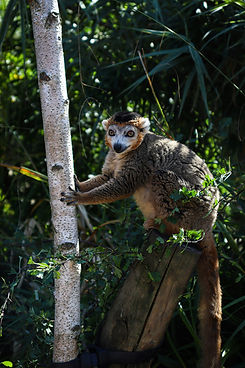
Crowned lemurs are small, endangered primates endemic to the dry deciduous forests of northern Madagascar, known for a distinct, crown-like patch of orange and black fur on their heads.
The pair of crowned lemurs who call Fife Zoo home are part of the European Ex Situ Programme (EEP).

HABITAT
Crowned lemurs are endemic to the northernmost tip of Madagascar, inhabiting dry deciduous forests, semi-deciduous forests, and some humid rainforests.
DIET
Crowned lemurs. are primarily frugivorous, with 80–90% of their diet consisting of ripe and unripe fruits. They are opportunistic omnivores, foraging in the canopy for young leaves, flowers, and nectar, and occasionally consuming insects, small vertebrates, and bird eggs. This makes them important seed dispersers.

BEHAVIOUR
Crowned lemurs live in small groups, usually only five or six individuals, but up to 15 have been observed. Females rule the group, getting first pick of foraging spots and their choice of mates.
Crowned lemurs tend to spend most of their time among thick vines and foliage, and on the very end branches of trees.
They have been observed delicately making their way across the Tsingys' sharp limestone karst spires.
THREATS
Lemurs are the most endangered mammal group in the world.
Crowned lemurs are Endangered on the International Union for Conservation of Nature (IUCN) Red List of Threatened Species.
Habitat loss due to logging, agriculture and fire is one of the biggest threats to lemur numbers, as well the pet trade.